

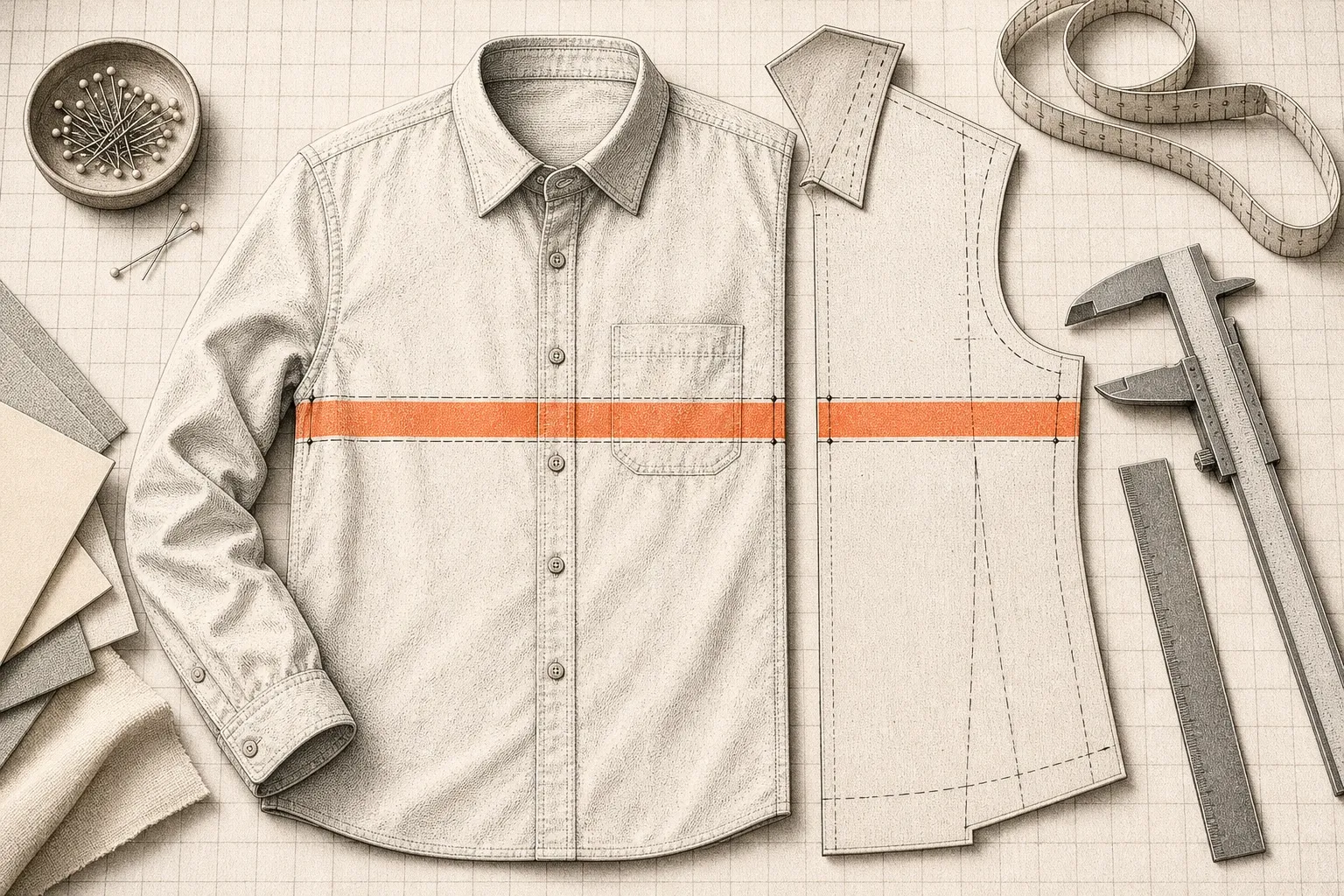
A tolerance is an agreed decision boundary, not permission for every measurement to drift.
A specification without tolerances tells a supplier the target but not how variation will be judged. A tolerance copied across every point of measure is not much better. Garments behave differently by material, construction, size and measurement method.
Useful tolerances reflect manufacturing reality while protecting fit, function and appearance. They help development and quality teams make consistent calls instead of renegotiating acceptance at every inspection.
Start with a repeatable measurement method
Define how the garment is conditioned, laid out and measured. Name the landmarks, whether the measurement is straight or along a curve, and the tension applied to elastic areas. Add a simple diagram or annotated image. If two trained people cannot reproduce the measurement, tightening the tolerance will not improve quality.
Set tolerance by risk
- Fit-critical points such as chest, waist, rise and key lengths usually need closer control.
- Functional points must protect movement, closure or component compatibility.
- Visual symmetry points need rules that consider both absolute measurement and left-to-right difference.
- Low-impact internal or decorative points may accept wider process variation.
- Stretch and washed products need conditioning and recovery assumptions.
Use past sample and production data where available. If a process cannot repeatedly hold the desired boundary, investigate pattern, method, machinery or material before writing an impossible specification.
Keep target, tolerance and grading separate
The target is the intended finished measurement. Grading defines how that target changes between sizes. Tolerance defines acceptable manufacturing variation around each size target. Mixing these concepts can accidentally allow a garment to measure closer to the adjacent size.
Define what happens outside tolerance
- 1Confirm the measuring method and remeasure.
- 2Check whether the issue is isolated or systematic across the sample.
- 3Assess fit, function, appearance and size separation.
- 4Record a pass, concession, correction or rejection with an owner.
- 5Feed recurring failures back into pattern, construction and supplier process review.
Control tolerance changes like product changes
Do not widen a tolerance quietly to make a failing sample pass. Record why the boundary changed, who approved it and which sizes or orders are affected. Reissue the measurement chart as a controlled revision and make the effective stage clear.
Track first-pass measurement approval, repeat failures by point of measure and differences between sample and production performance. Over time, this evidence helps technical teams focus attention where variation creates real customer risk.